Belt
A battery belt that powers your ΠAN Gear and your phone, and comes off in one pull.
- 44.2 Wh
- About 1.8 phone charges
- 6 LiFePO4 cells in steel cassettes
- USB-C 5 V 1.5 A and 3 A
- One pull release
- Bluetooth
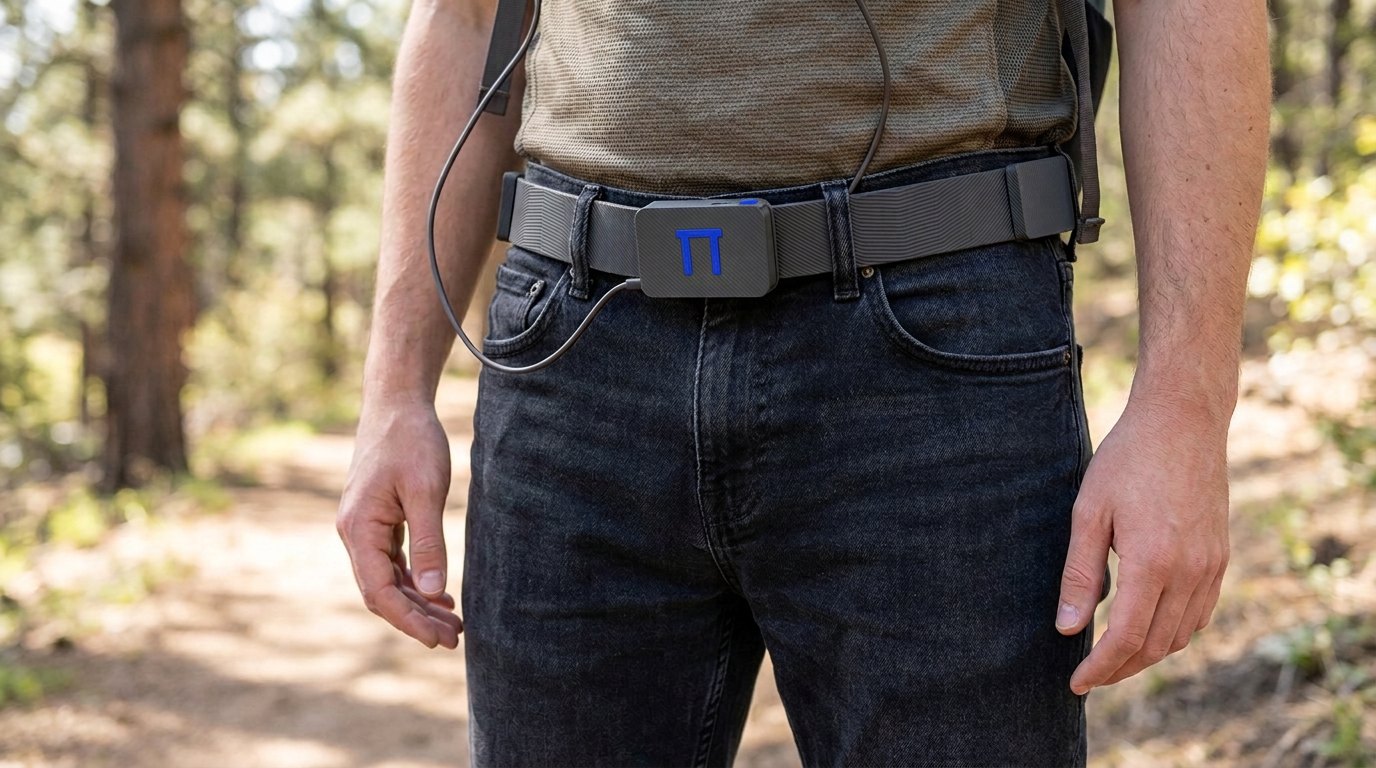
What it is
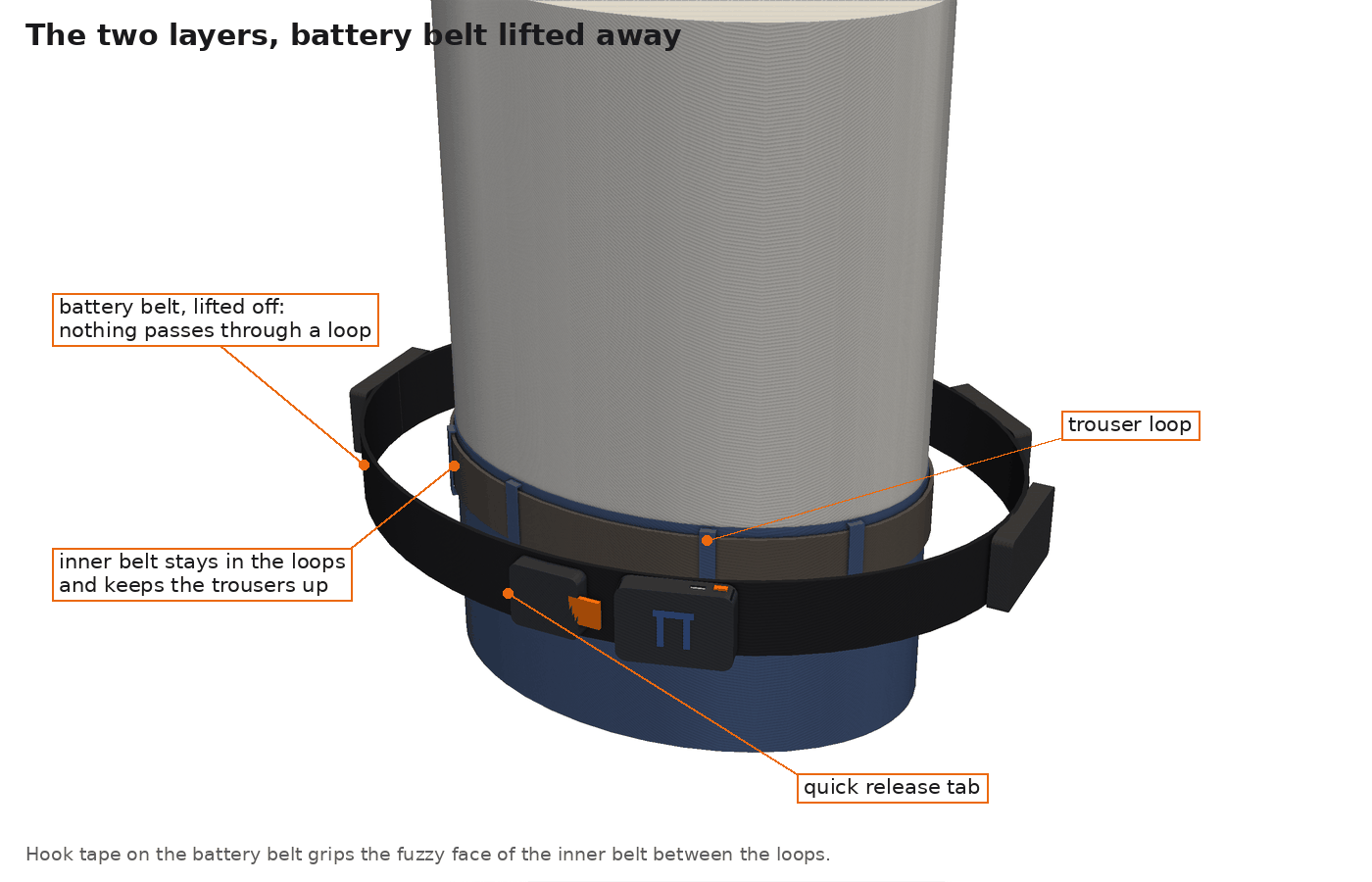
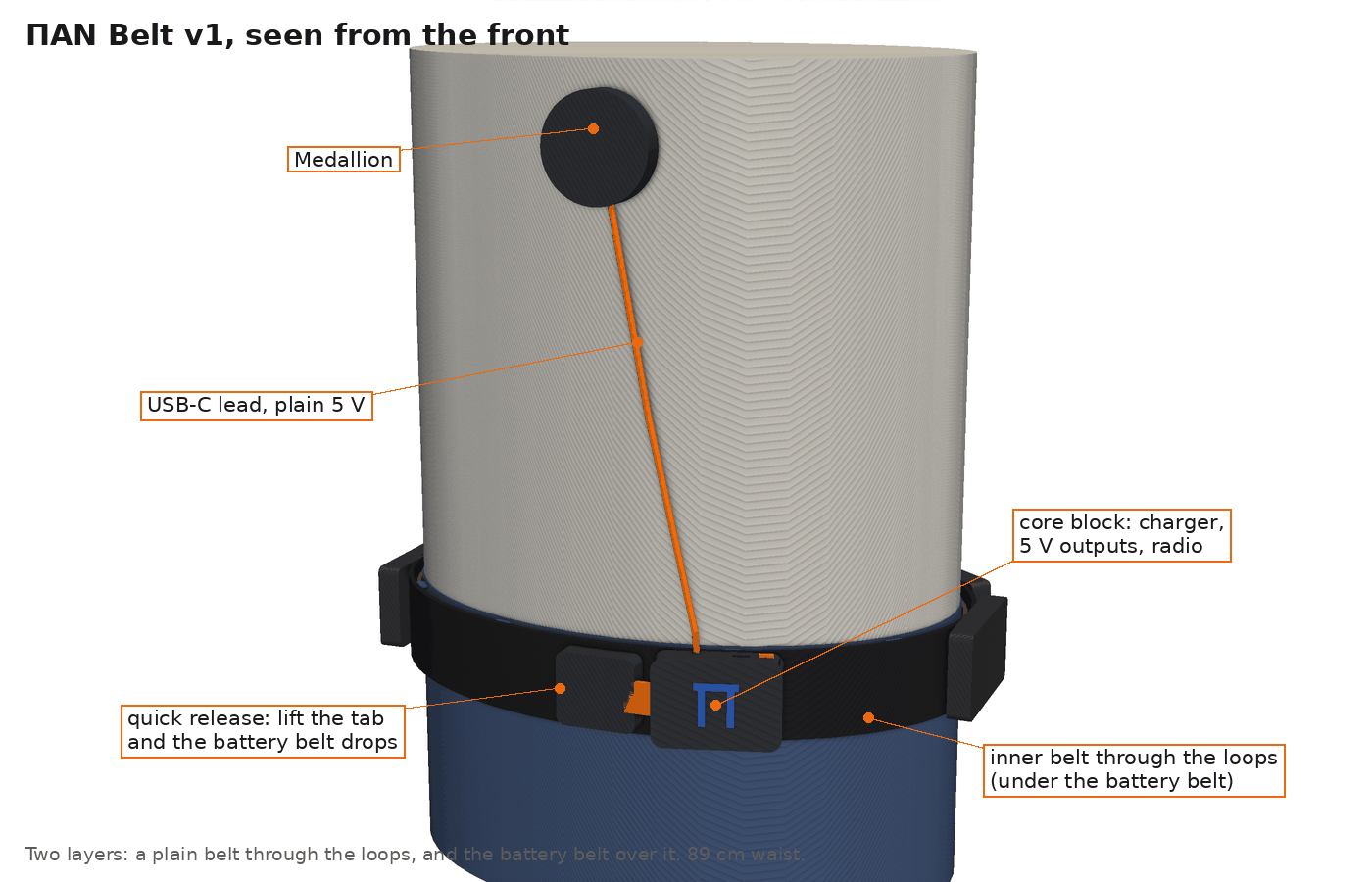
The Belt is two layers. A plain 38 mm belt threads through your trouser loops and holds your trousers up. The battery belt, 50 mm tall, sits over it and over the loops, gripped by hook tape, and closes with a magnetic release at the front. Lift the tab and the battery belt peels away in one motion; nothing has to slide through a loop.
Six flat LiFePO4 cells sit along the back and sides, one in each steel cassette. Together they store 44.2 Wh: about 1.8 phone charges, or 4.6 refills of the Medallion. A core block at the front left holds the charger, two USB-C outputs, a Bluetooth radio and a button.
Every safety limit is in hardware: each cell has its own protection chip and fuse, the charging voltage is fixed by the charger's strap, and each output socket limits its own current. A temperature sensor on every cell lets the belt warn you.
With ΠAN
- Powers the Medallion: about 4.6 full refills. Its lead runs from the top of the core block up your chest.
- Charges your phone from the bottom socket, about 1.8 times over.
- The phone is the brain. The Belt reports its charge and cell temperatures over Bluetooth and vibrates when told; it decides nothing on its own.
- ΠAN can tap you at the front, at either hip or at your back: cues you feel without looking at a screen.
The real design, in 3D
Made straight from the design's CAD files. Turn it and zoom in.
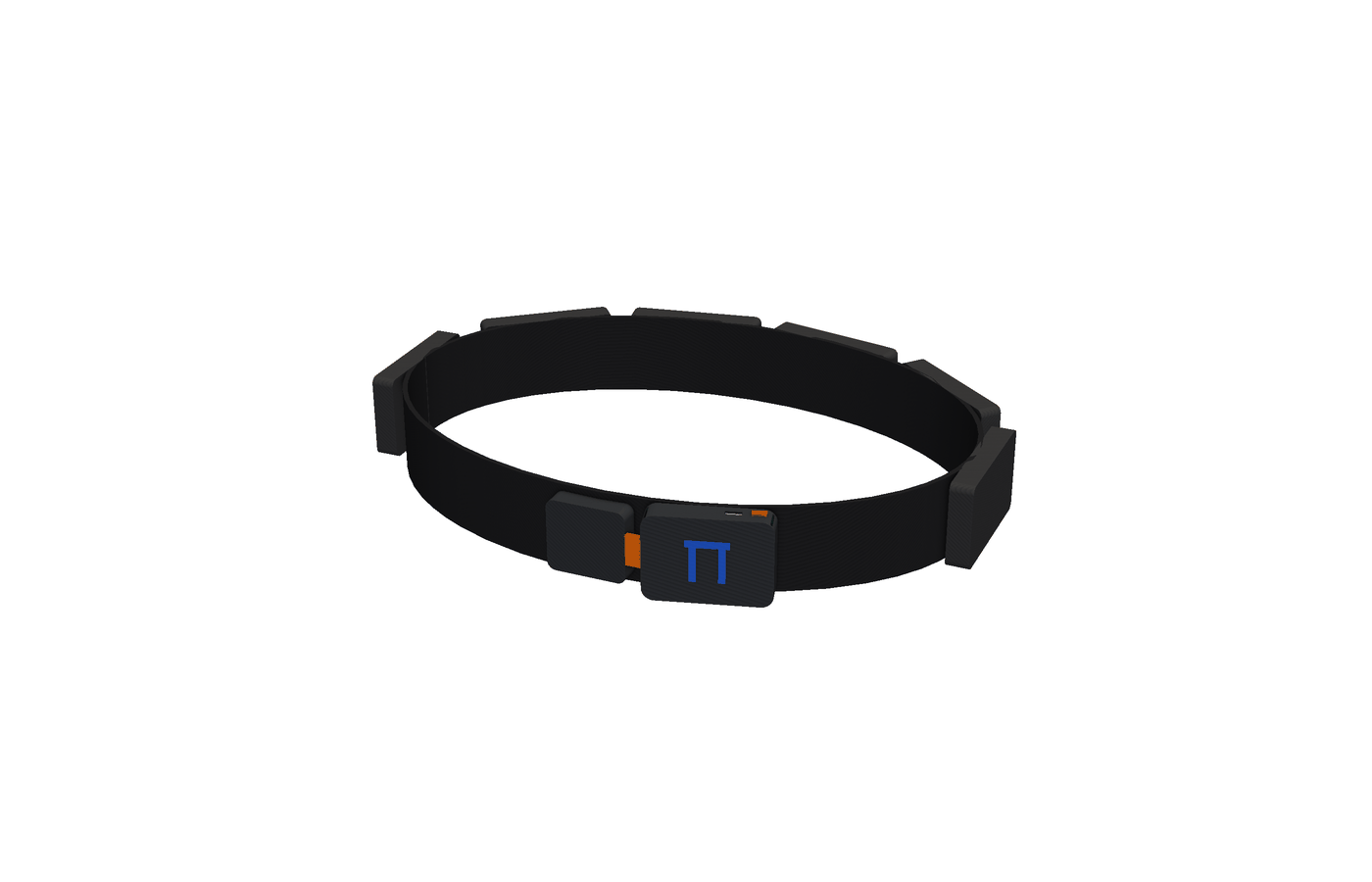
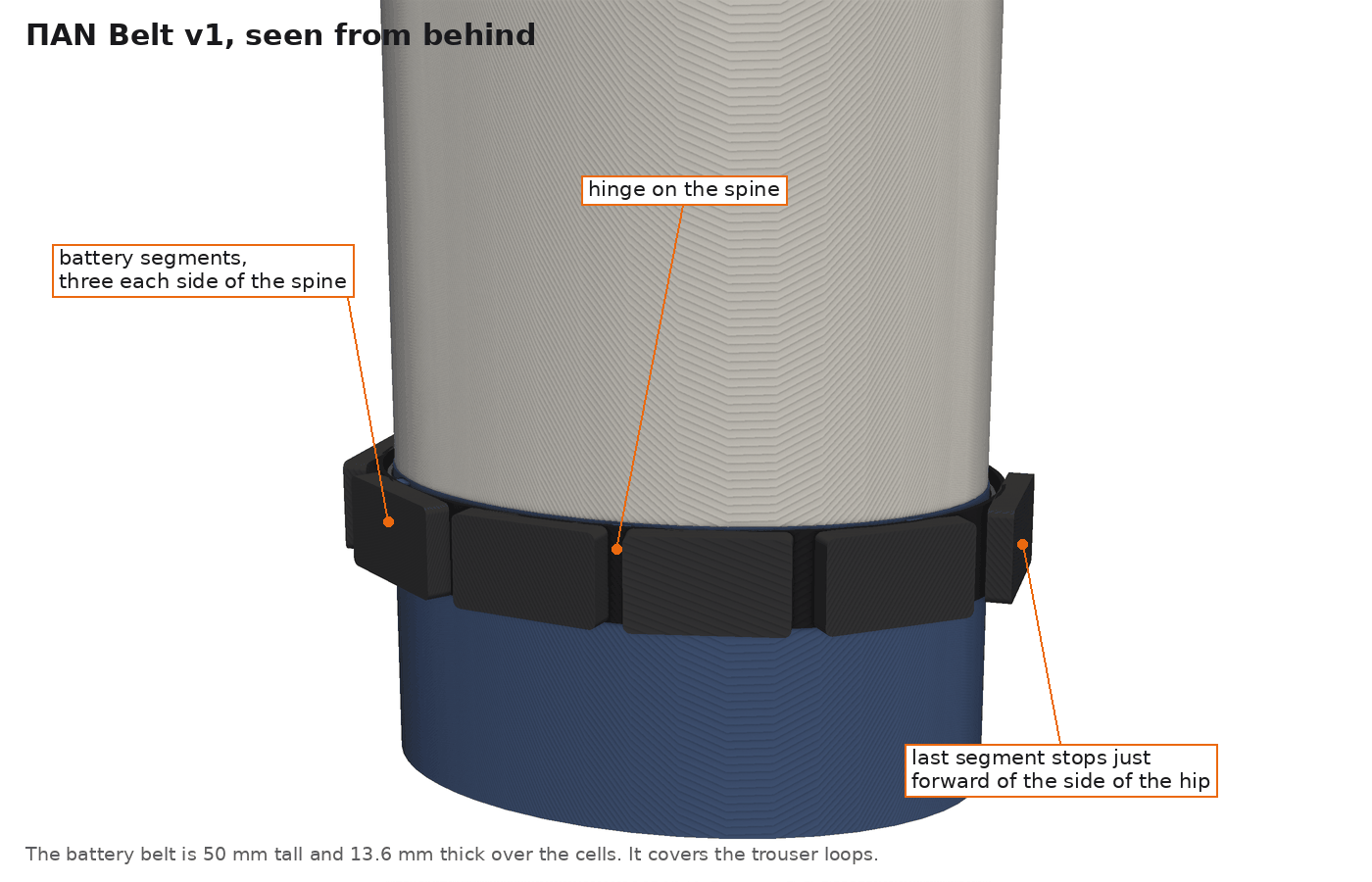
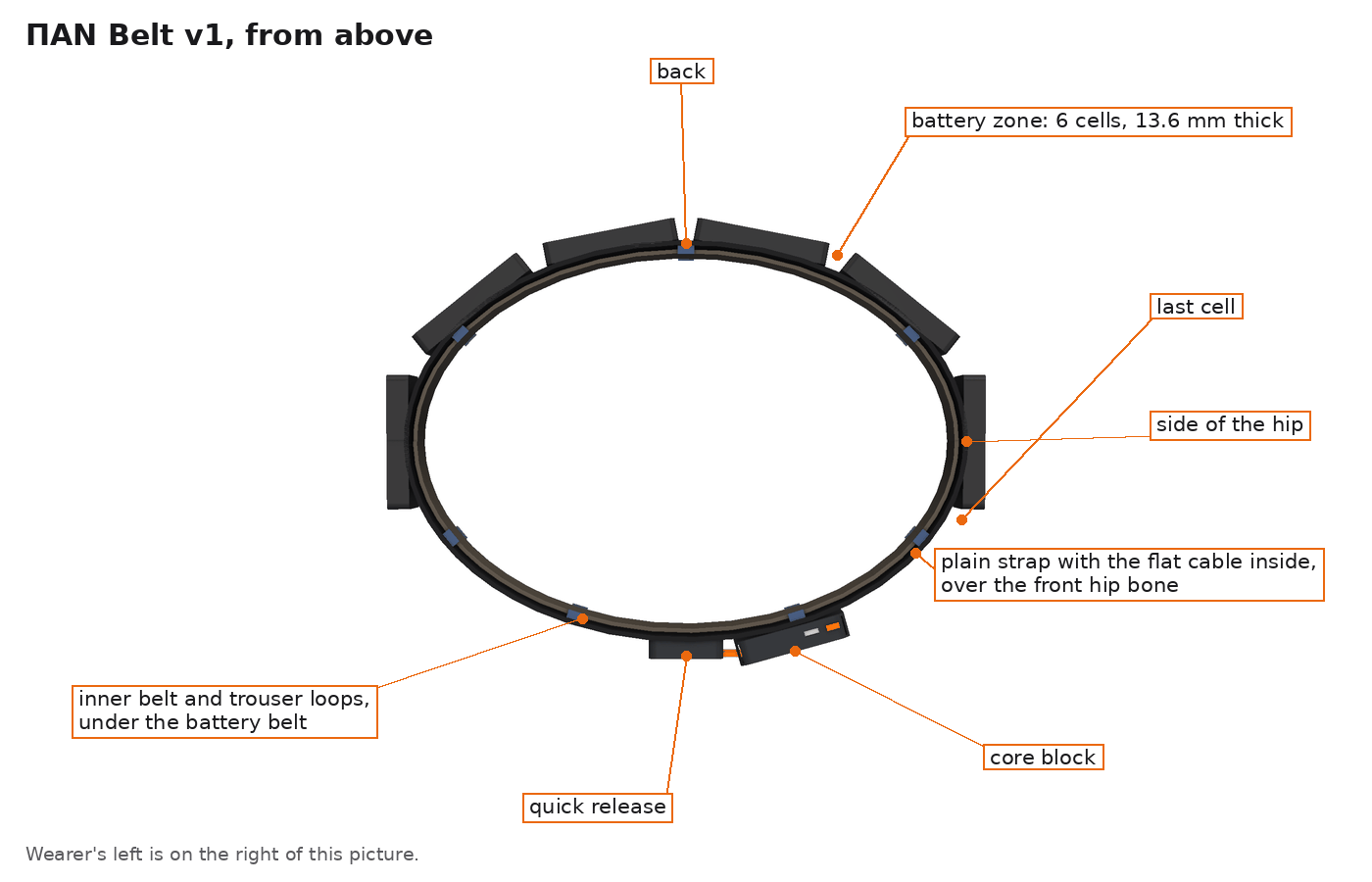
Both layers: the plain inner belt, and the battery belt with its six segments, the core block and the release. Drag to turn. Click, then scroll to zoom; pinch on a phone.
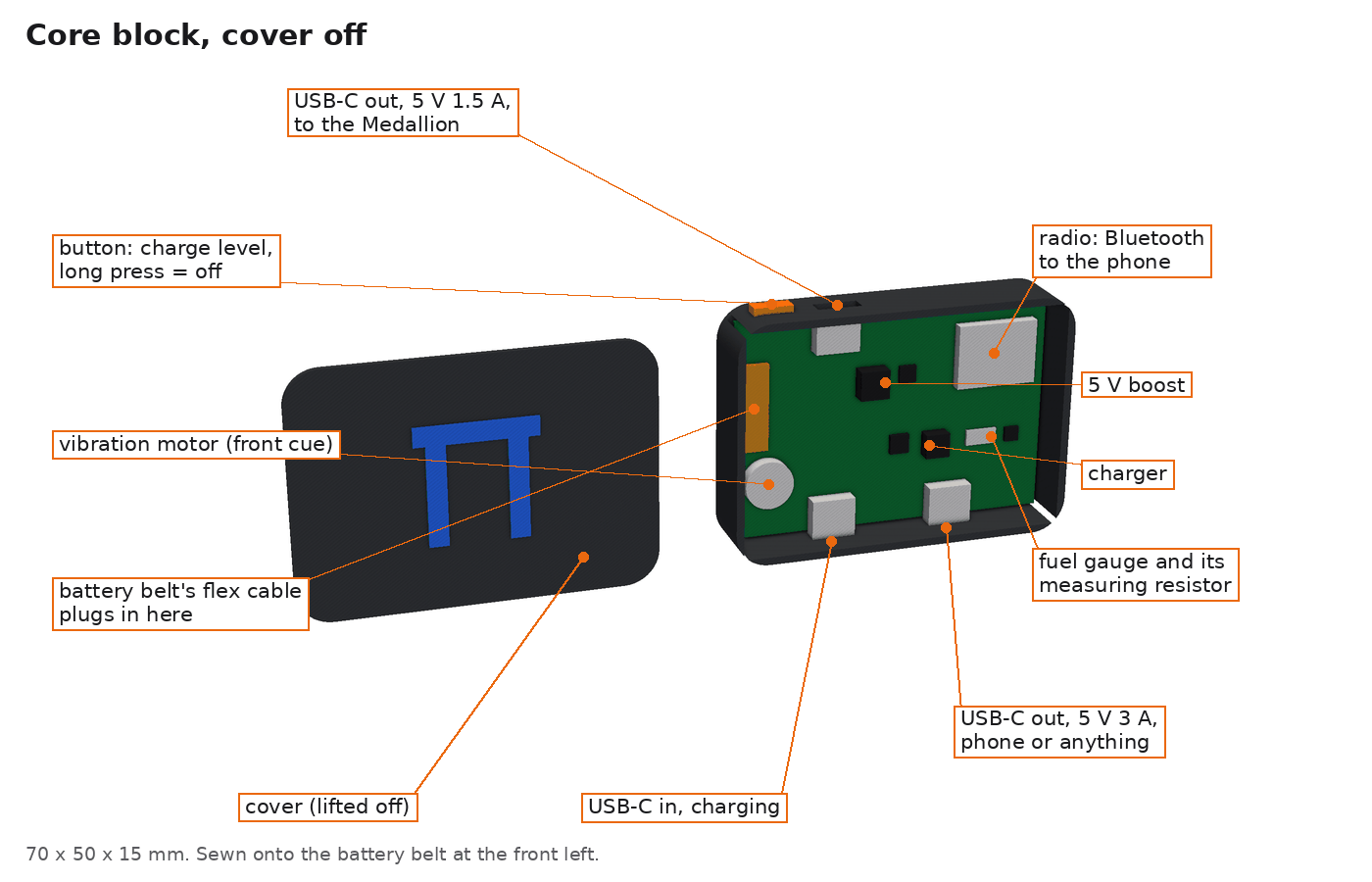
The core block with its cover lifted off: the board with the radio, charger, boost, fuel gauge, vibration motor and three USB-C sockets. Drag to turn. Click, then scroll to zoom; pinch on a phone.
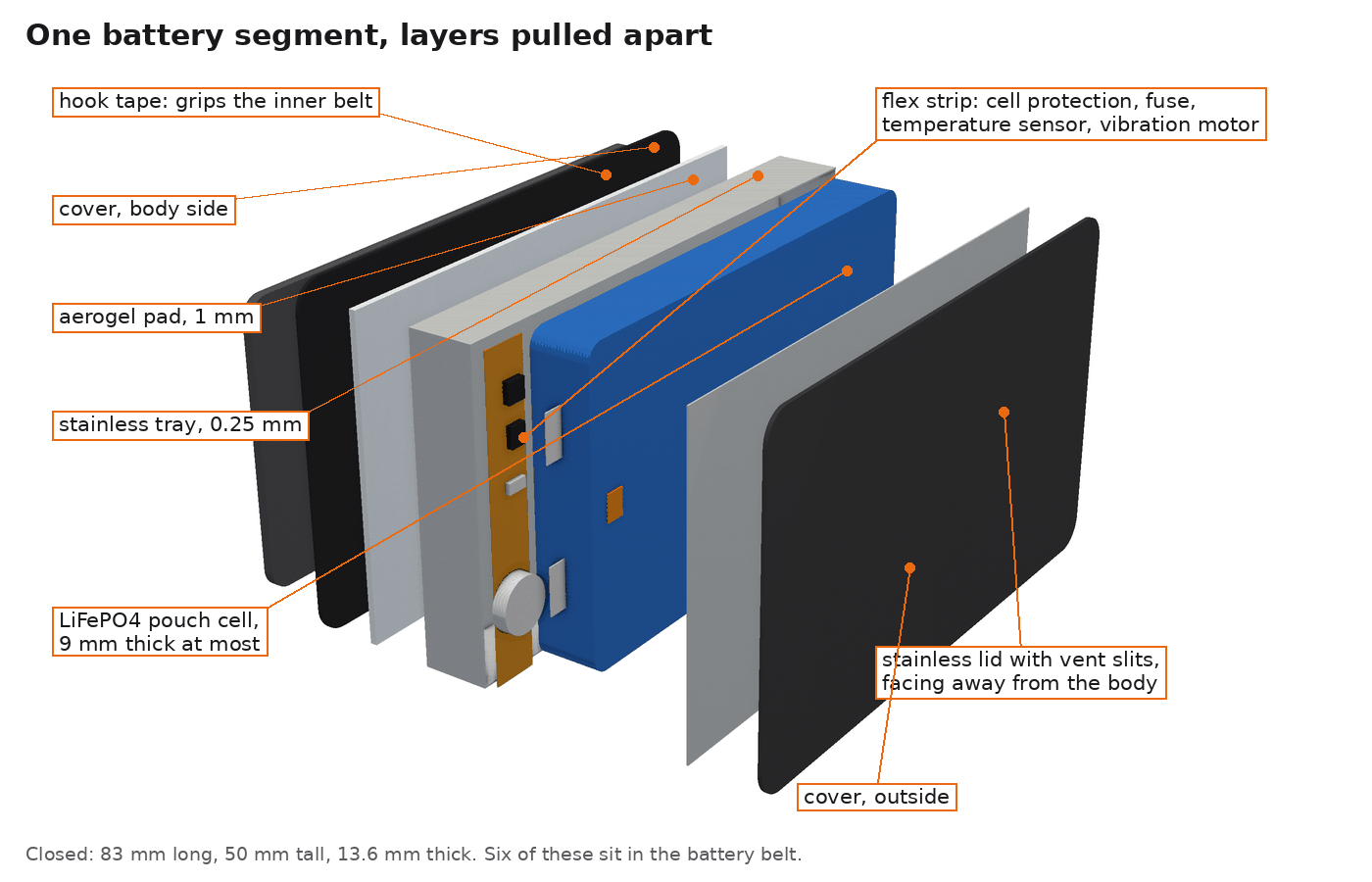
One battery segment, layers pulled apart: hook tape, cover, aerogel pad, steel tray, the cell, the flex strip with its protection parts, the vented steel lid and the outer cover. Drag to turn. Click, then scroll to zoom; pinch on a phone.
How the parts work
Inner belt
A plain 38 mm belt, about 2.5 mm thick, with a fuzzy outer face. It threads through ordinary trouser loops and holds the trousers up, so the battery belt never has to fit a loop.
Battery belt
50 mm tall, with hook tape on the body side that grips the inner belt between the loops. The battery zone runs along the back and sides: six segments, three on each side of the spine, with a hinge on the spine. The front is plain strap, 3 mm thick, with only the flat cable inside, so no cell sits under a car's lap belt.
Release
A magnetic buckle at the front centre opens with one hand, under load, by lifting a tab. Then the battery belt peels off the inner belt.
Battery segments
Each cell sits in its own stainless steel cassette, 83 x 50 x 13.6 mm closed: hook tape, a cover, a 1 mm aerogel pad on the body side, a 0.25 mm steel tray, the cell with room to swell, and a steel lid with vent slits facing away from the body. The belt bends only at the hinges between segments.
Cell protection
Every cell has its own protection chip, switch, fuse and temperature sensor on the flex strip at the end of its segment. The chip cuts the cell off above 3.75 V, below 2.10 V, on overcurrent, and within 300 microseconds on a short circuit. A 10 A fuse in the core block guards the whole pack.
Core block
70 x 50 x 15 mm, at the front left, and it holds all the electronics. The Medallion's socket is on its top edge; the phone socket and the charging socket are on its bottom edge.
Charging
USB-C in, plain 5 V. The charger is fixed at 3.6 V by its strap and charges at 3 A, in about 5 hours. A thermistor on a middle cell stops charging below 0 °C and above 45 °C, in hardware.
Outputs
Two USB-C sockets behind a 5 V boost converter. The top one feeds the Medallion: 5 V 1.5 A, limited at 1.72 A. The bottom one feeds a phone or anything else: 5 V 3 A, limited at 3.4 A. Each socket stays off until something is plugged in.
Radio and button
An ESP32-C6 talks Bluetooth to the phone and the Medallion. A fuel gauge counts the charge and a motion sensor sits beside it. A press of the button shows the charge level; a long press turns the belt off.
Vibration
Five coin motors: one in the core block at the front, one in the last segment at each hip, and one each side of the spine that pulse together for the back. Each cue is a pulse of 200 ms or more.
Wiring
One flat 2 layer flex circuit runs from the core block through all six segments: plus on one layer, minus on the other, with the motor, sensor and thermistor lines beside them. No chip in the belt runs software.
Specs
- Battery belt
- 50 mm tall. 13.6 mm thick over the cells, 3 mm elsewhere
- Inner belt
- 38 mm tall, about 2.5 mm thick, through the trouser loops
- Cells
- 6 LiFePO4 pouch cells, 2300 mAh each, in parallel
- Energy
- 44.2 Wh (13.8 Ah at 3.2 V)
- Delivers
- About 1.8 phone charges or 4.6 Medallion refills
- Outputs
- USB-C 5 V 1.5 A (Medallion, top of the core block) and USB-C 5 V 3 A (phone, bottom)
- Charging
- USB-C, plain 5 V, about 5 hours
- Release
- Magnetic buckle at the front, one hand, then the belt peels off
- Radio
- Bluetooth (ESP32-C6)
- Feedback
- Vibration at the front, hips and back; button
- Core block
- 70 x 50 x 15 mm
- Weight
- Battery belt about 780 g, inner belt about 100 g
- Sizes
- Three lengths; the tail adjusts to fit
- Flying
- 44.2 Wh, under the 100 Wh cabin limit. It travels as a power bank, in the cabin
Safety, in hardware
| What could go wrong | How the design handles it |
|---|---|
| Overcharge | The charger is fixed at 3.6 V by its strap, and each cell's own chip opens at 3.75 V |
| Charging a cold or hot cell | The charger's thermistor input stops charging below 0 °C and above 45 °C |
| Deep discharge | Each cell's chip opens at 2.10 V |
| A short in the belt or core block | Each cell's chip opens within 300 microseconds, then each cell's fuse |
| Overload | A 10 A pack fuse in the core block and a 3 A fuse on each cell |
| One cell shorts inside | Its fuse and switch cut it off from the other five |
| Too much current at a socket | Each socket limits in hardware: 1.72 A and 3.4 A |
| Bending or sitting on a cell | Each cell has its own steel cassette, and the belt bends only at the hinges |
| A cell overheating | LiFePO4 cells, steel cassette, aerogel pad on the body side, 16 mm to the next cell, vents facing away from the body, and a temperature sensor on every cell that sets off a warning |
| Getting it off | One hand lifts the release tab and the battery belt peels away; nothing passes through a trouser loop |
| A car crash | No cell under the lap belt and no cell on the spine |
Parts list
Every part in the battery belt and the core block: what it is, its size where it matters, and how many.
Battery belt13 lines, 51 parts
| Value | Package | Qty |
|---|---|---|
| LiFePO4 pouch cell, 2300 mAh | 9.0 x 45.5 x 73 mm | 6 |
| HY2112-AB, cell protection | 6 | |
| AO8810, dual N MOSFET | 6 | |
| Fuse, 3 A, one time | 6 | |
| Thermistor, 10 k, cell temperature | 6 | |
| Thermistor, 10 k, charger | 1 | |
| Coin vibration motor, 3 V | 8 mm | 4 |
| Cassette tray and lid, stainless 304 | 0.25 mm sheet | 6 |
| Aerogel pad | 1 mm | 6 |
| Flex circuit, 2 layer, 2 oz copper | about 650 mm | 1 |
| Webbing with hook tape | 50 mm | 1 |
| Magnetic quick release buckle | 40 mm | 1 |
| Inner belt with loop face | 38 mm | 1 |
Core block16 lines, 22 parts
| Value | Package | Qty |
|---|---|---|
| BQ25300, charger | 1 | |
| 5 V pass through switch | 1 | |
| Fuse, 10 A, one time | 1 | |
| TPS61088, 5 V boost | 1 | |
| TPS25821, USB-C source switch, 1.5 A | 1 | |
| TPS25810, USB-C source switch, 3 A | 1 | |
| Fuel gauge with sense resistor | 1 | |
| Analogue multiplexer, 8 channel | 1 | |
| ESP32-C6-MINI-1, processor and radio | 1 | |
| 3.3 V buck boost converter | 1 | |
| QMI8658A, motion sensor | 1 | |
| USB-C socket | 3 | |
| Coin vibration motor, 3 V | 10 mm | 1 |
| N MOSFET, motor switch | 5 | |
| Tactile switch | 1 | |
| Shell | 70 x 50 x 15 mm | 1 |
Pictures
Renders and drawings from the design files.
Design files
The Belt is an open design. Build it, sell it, improve it.
- DesignThe design notes: every choice with its numbers, the wiring, the safety layers and the parts list
- CADThe CadQuery script, and STEP files for one segment, the core block and the whole belt
Make one
Every ΠAN Gear design is open. Build the Belt, sell it, improve it. Tell us at makers@thepanproject.com and we test it with ΠAN, help you get it right, and feature it here.