Power armor
A powered suit for search and rescue, built around the person inside.
- Fits 1.60 to 1.95 m
- 6 battery modules of 1.5 kWh
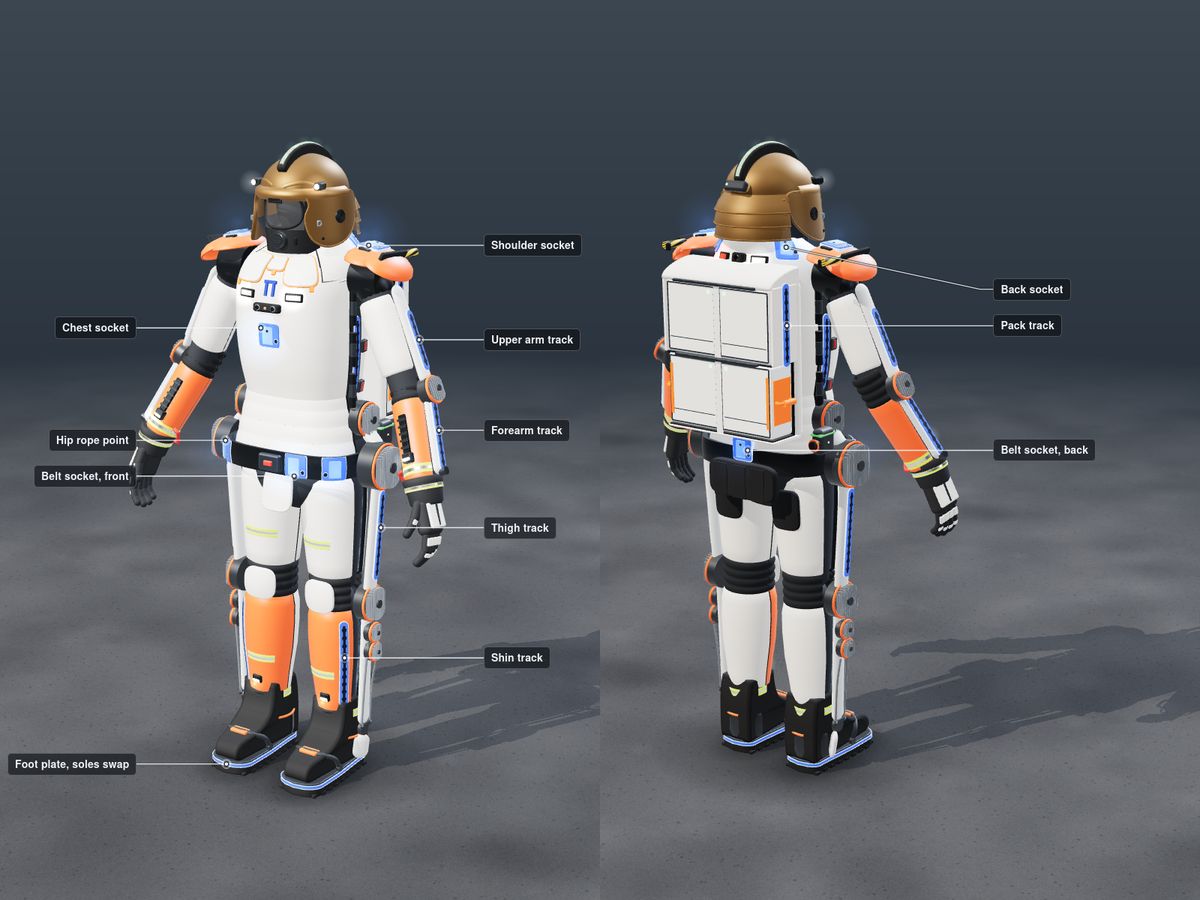
- 11 sockets, 12 track strips
- 1 t winch
- Out in 5 to 10 s
What it is
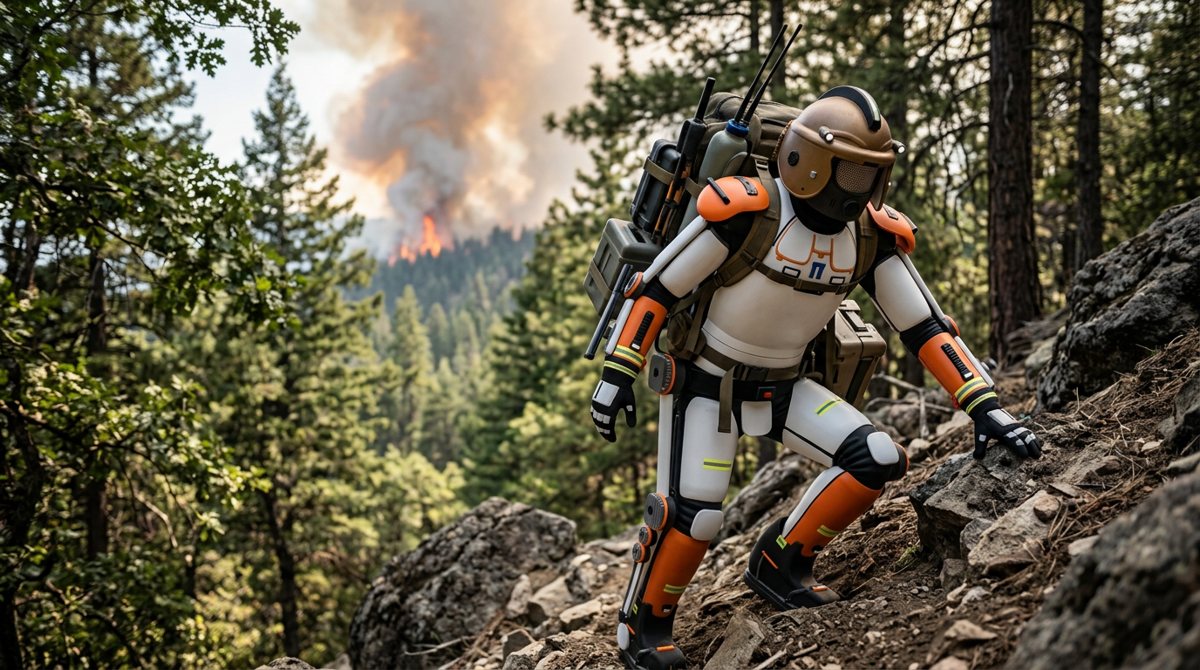
The Power armor is a powered suit for search and rescue. You back into it, the plates close around you, and motors at the hips, knees, ankles, lower back and shoulders carry the suit's weight and add to your strength. It carries rescue tools only.
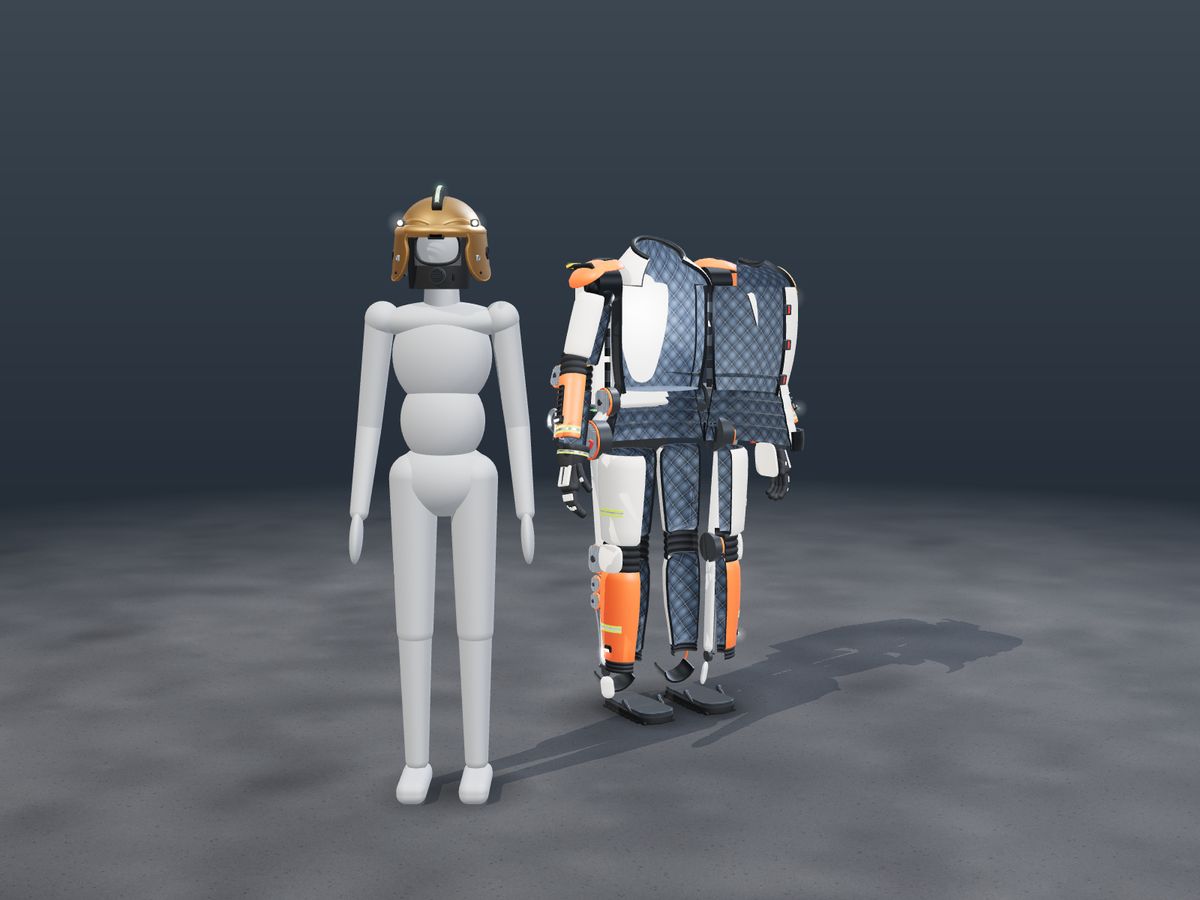
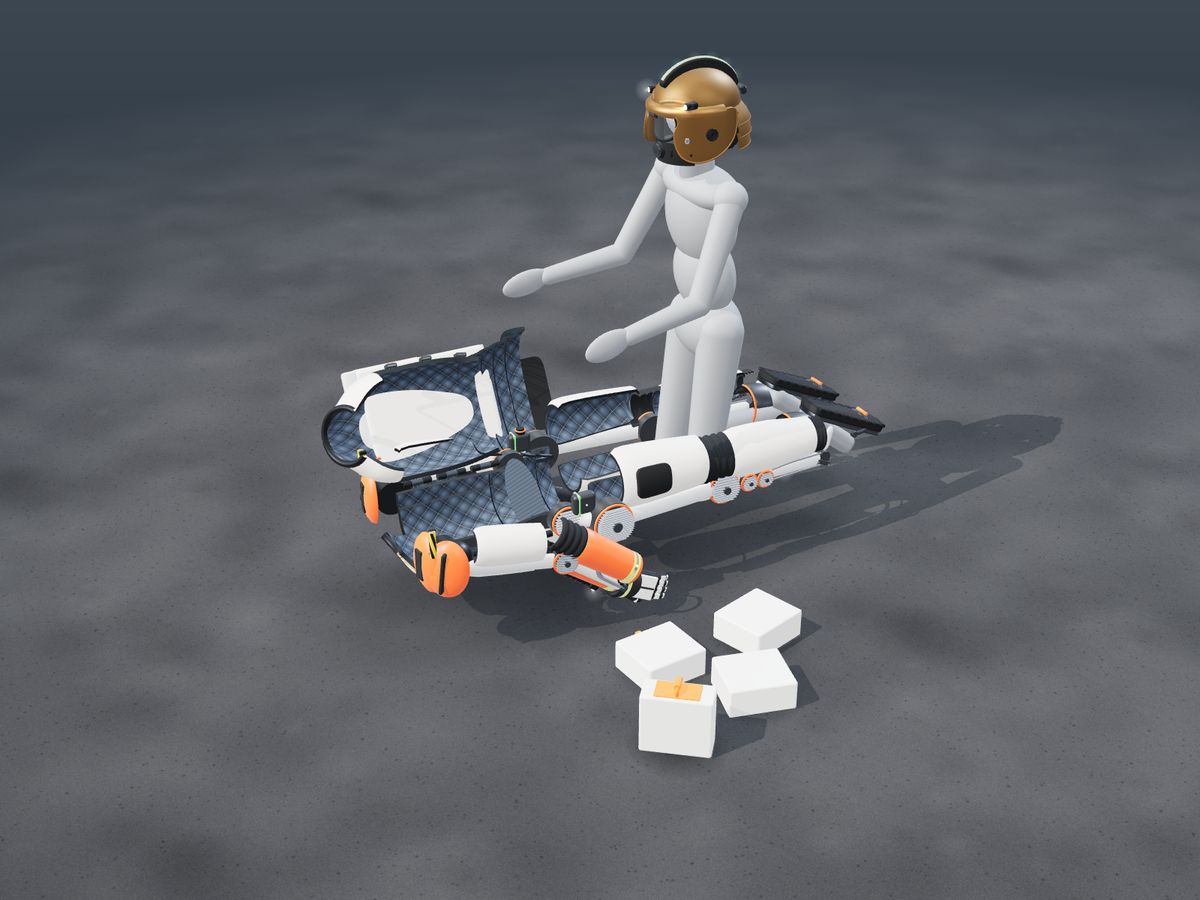
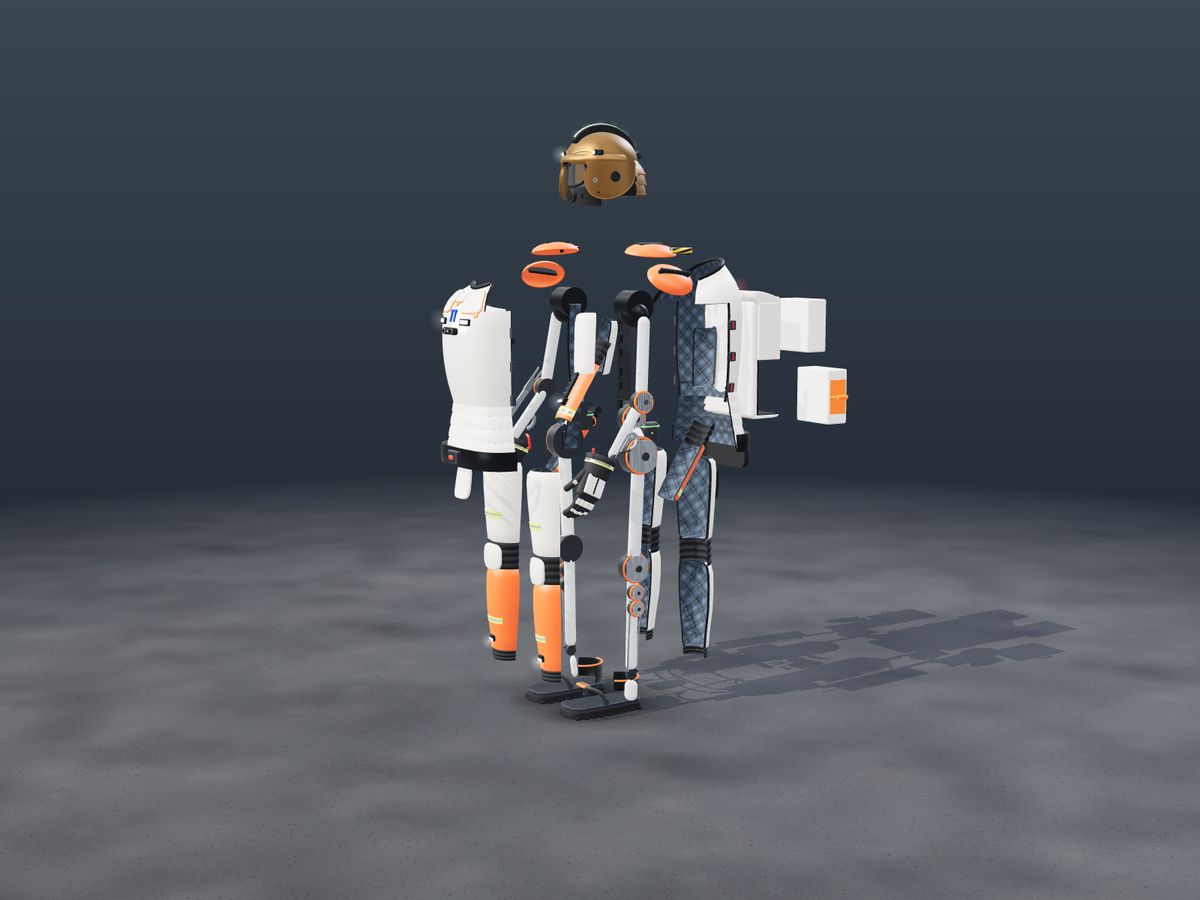
Two side frames carry every motor, from the foot plates up the outside of the legs to the shoulders. The torso and every limb are plates that swing open like book covers, from the front or from the back.
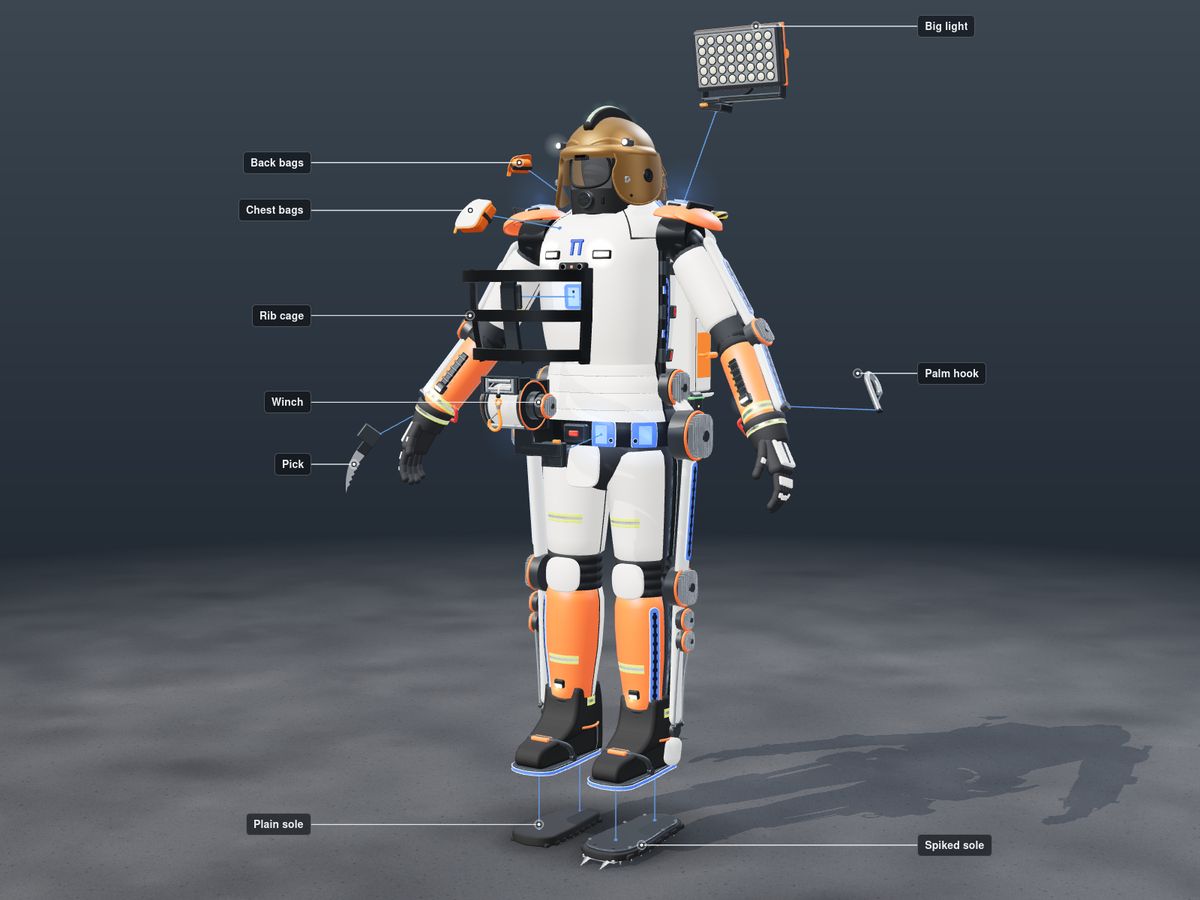
It is one core suit with mounts. Feet, spikes, airbags, a rib cage, a winch, a big light, an air set and tools are kits that clip on, so every job gets its own loadout.
It is built for the work no machine reaches and a person has to do: steep ground for wildland fire crews and tree fallers, rescue and search in big buildings, mountain carry outs, collapsed buildings and floods.
With ΠAN
- Opens by voice: say the word, or pull the two red handles inside the wrists together.
- The helmet has its own battery, a thermal camera, speakers and outside microphones, and ΠAN voice. It keeps working when the suit is off.
- The helmet shows what the suit carries: the weight left before its walking limit, where your weight sits over your feet, and any kit that is not locked in.
- Every kit carries a chip with its name, its weight and where that weight sits. The suit reads it and corrects its balance.
- The suit's computer runs the winch: it holds the line force, pays out as the suit walks down a slope, and stops when the load jumps.
- Trapped under rubble, the suit keeps you warm and calls out its own position for days.
The real design, in 3D
Made straight from the design's 3D model. Turn it and zoom in.
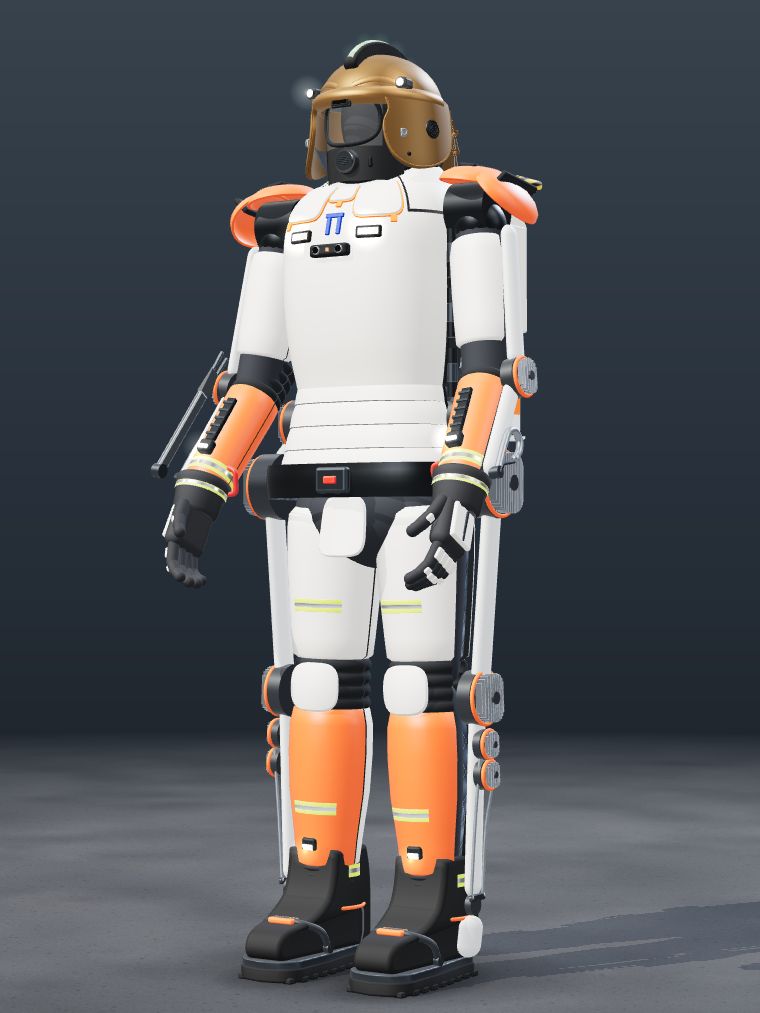
The core suit with its helmet, plates, side frames and battery modules. Drag to turn. Click, then scroll to zoom; pinch on a phone.
How the parts work
Frame and plates
Two side frames carry all the motors, so the heavy parts never move when the suit opens. The torso is two halves: the front hinged at your left side, the back at your right. Every limb segment is a clamshell hinged on the outside rail. Your own boots click into the foot plates, like a snowboard binding.
Getting in and out
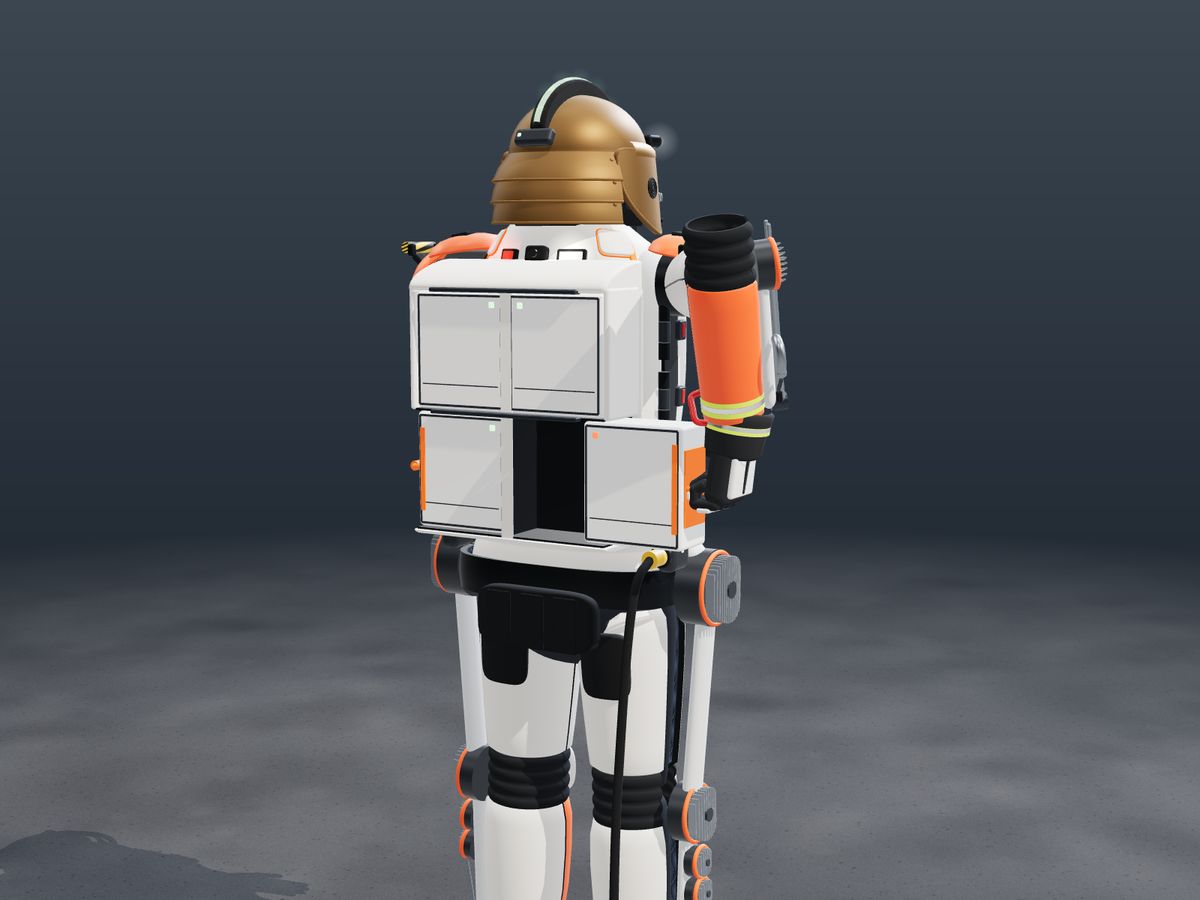
Step back into the bindings and lean into the frame; the plates close. To get out, the front half and front limb plates swing open and you step out forward in about 5 to 10 seconds. Face down, the battery modules drop, the back swings up on gas struts and you climb out the back in about 15 to 20 seconds.
Latches
Every latch is pulled by a cable, so all of them open with no power. A yellow and black rescue handle on each shoulder lets the team open the suit from outside.
Battery
Up to six slab modules on the back, 1.5 kWh and about 7.3 kg each. Each has its own battery manager, fuse and contactor. A module that overheats is cut off and can drop off the back while the rest keep the suit running. A 0.3 kWh reserve in the side frames stays on when the modules are out.
Motors and joints
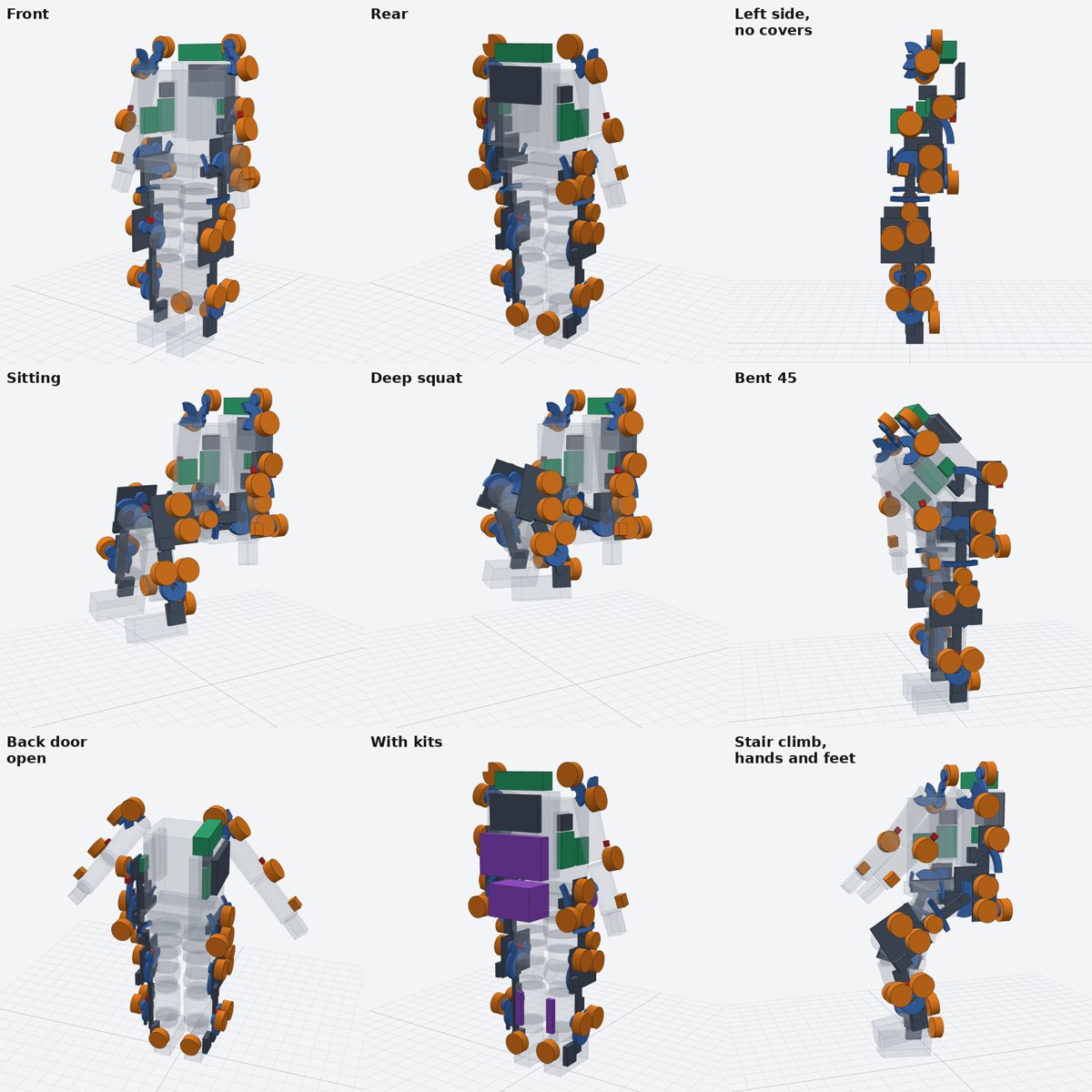
Electric motors drive the hips, knees, ankles, lower back, shoulders and elbows, the big joints through steel gear stages, every motor on the outer face of its joint. The work leg build has 25 motors. Every motor, gear, lock and box is modelled at its real size and checked in 28 poses, from a deep squat to both doors open, so no two parts share a space. A spring loaded tooth drops into a ring of notches on each big gear and holds any pose with no power.
Feel and balance
Force sensors in every cuff measure how you push, and the motors move to keep that push near zero, so the suit's weight disappears. You feel the ground through your own boots. The suit balances its own weight the way humanoid robots do, correcting at the ankles and hips.
Helmet
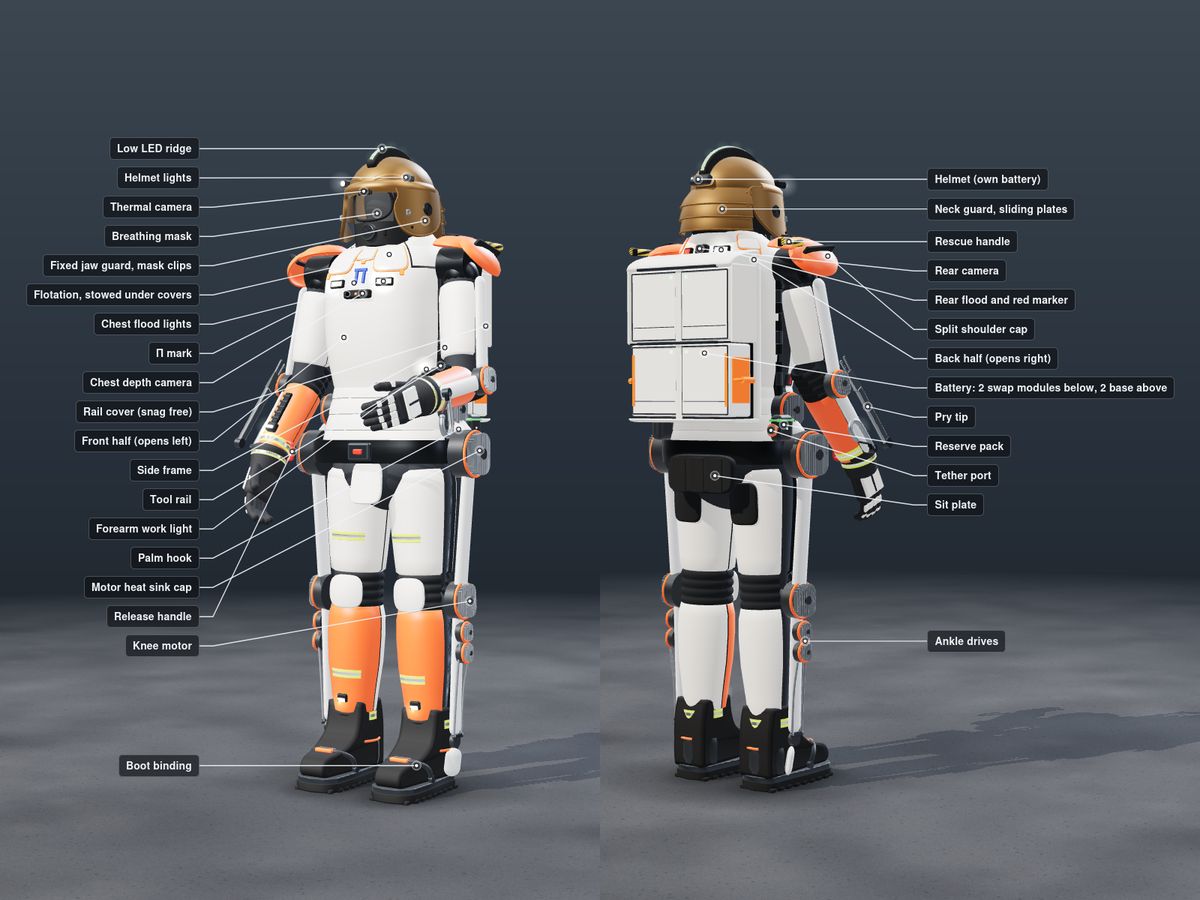
Your own helmet, with its own battery: a breathing mask under a composite shell, fixed jaw and ear guards that hold the mask clips, speakers and outside microphones, a thermal camera under the brow, and a low crest with the LED strip and antennas. It locks to the collar ring, so a load on the head goes into the frame, not your neck.
Hands
Your own fingers in powered gloves for fine work. A locking palm hook folds out under each wrist for handles, straps and the stretcher, and the frame carries the load. For a beam or a slab, both forearms go under it like forks.
Cameras
A thermal camera on the helmet, a depth camera at the breastbone that sees each step before the foot lands, and a rear camera for backing up with a stretcher.
Mounts
11 sockets, each built for 10 kN (about 1 t) in any direction, with a sealed plug for power and data. The belt and hip sockets are rope anchors. 12 strips of standard seat track take off-the-shelf fittings. A kit slides onto its socket and one pin with a big pull ring locks it, gloves on.
Winch
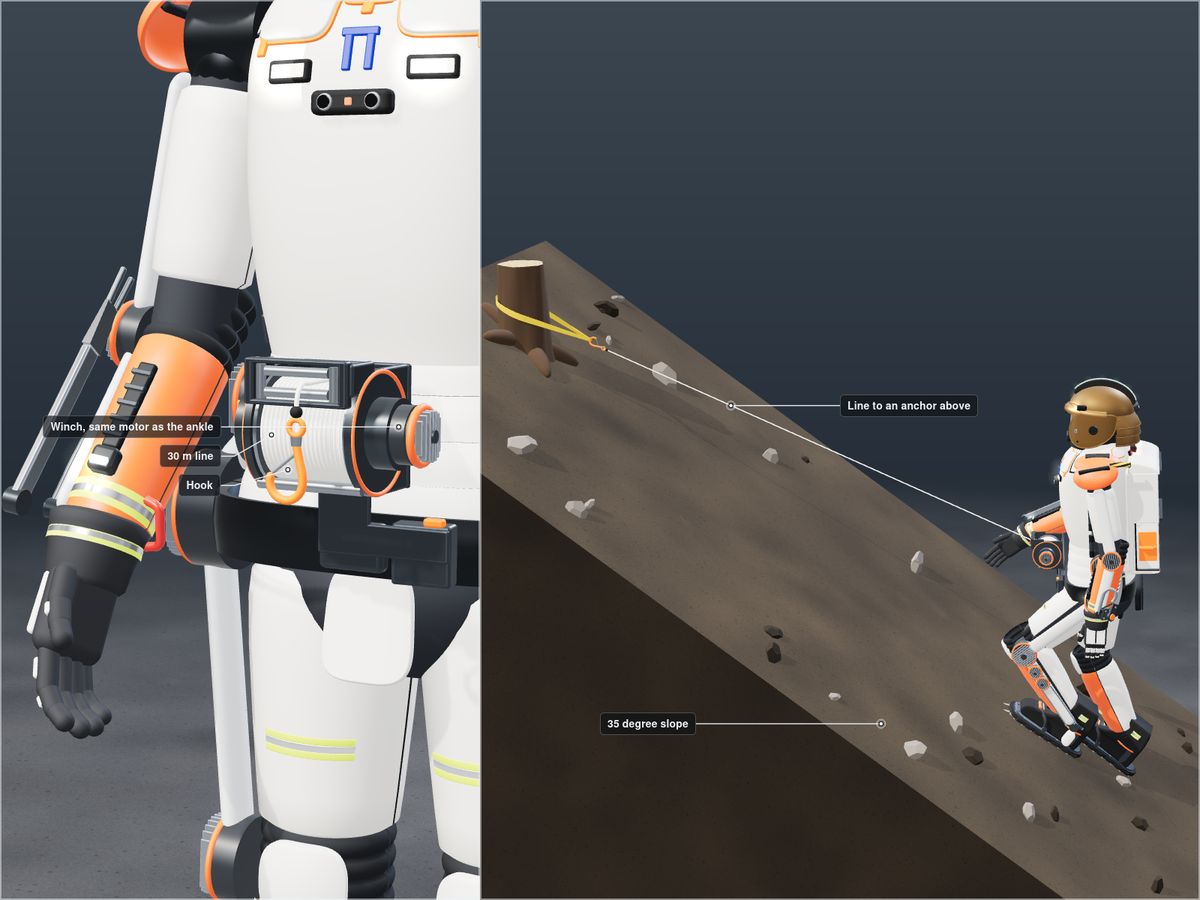
A leg motor, a 3 to 1 gear stage and a drum with 30 m of 6 mm synthetic line. It pulls 1 t on a single line and about 2 t with one pulley block, and has its own holding brake and ratchet. Tied back to a tree, a rock or a truck, the suit pulls with the full tonne.
Airbags and rib cage
Bags on the collar and chest float you face up in water. Wing bags on the upper back add 350 L for avalanches and falls. Under the torso plates, three aluminum hoops carry about 6 tonnes: a 4 x 4 m slab of concrete floor.
Wood stairs
On a sound wood stair the suit climbs sideways with its back to the wall, so the wall side board takes most of the load. On a doubtful stair, or one with open sides, it climbs on hands and feet: a padded hoop on each forearm takes the load, the elbows lock, and one limb moves at a time. No tread then carries more than about 55% of the weight.
Specs
- Height
- About 1.90 m for a 1.80 m wearer
- Fits
- Wearers about 1.60 to 1.95 m tall
- Width
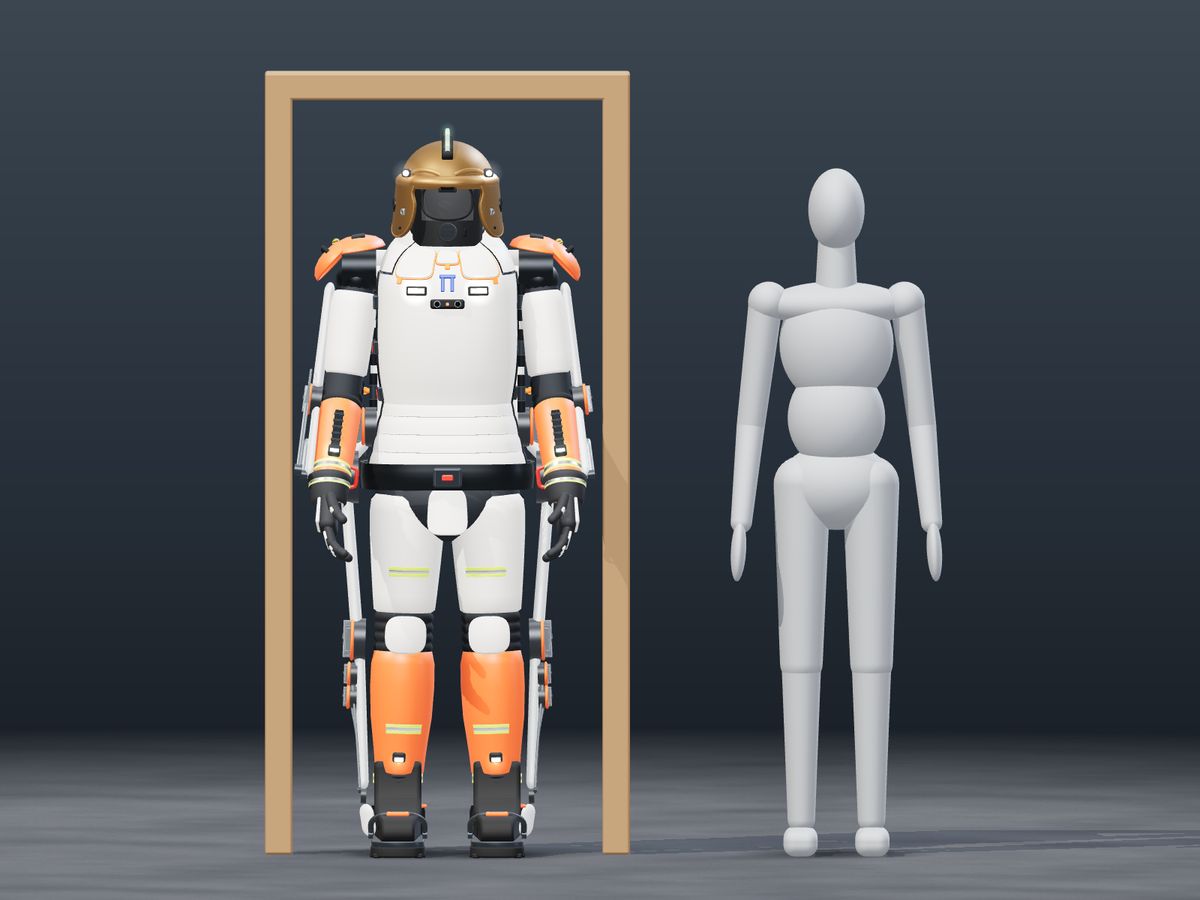
- About 0.75 m, through a door
- Weight
- About 171 kg with 4 battery modules
- Battery
- Up to 6 modules of 1.5 kWh, plus a 0.3 kWh reserve
- Walking time
- 3.6 to 4.9 hours on 4 modules, 5.4 to 7.4 hours on 6
- Carries
- 83 to 95 kg on the body
- Lifts
- 119 to 151 kg from the floor
- Winch
- 1 t pull, 30 m line
- Mounts
- 11 sockets at 10 kN, 12 track strips, 6 battery slots
- Getting out
- Front 5 to 10 s, back 15 to 20 s. Latches open with no power
- Build
- Aluminum frame, steel battery boxes
Two leg sets
Work leg
12 leg motors. Walks at about 5 km/h, climbs wood stairs sideways along the wall or on hands and feet, rides a rescue hoist, and carries 83 to 95 kg.
Fast leg
20 leg motors, water cooled, with spring blades in the calves. Runs at about 14 km/h outdoors and carries 56 to 67 kg.
Kits
Each kit goes on a mount and comes off again in about a minute, with no tools.
| Kit | Goes on | Weight |
|---|---|---|
| Palm hooks, pair | Forearm track | 1.2 kg |
| Forearm pad hoops for stair climbing, pair | Forearm track | 0.8 kg |
| Fold out pry tip | Right forearm track | 1.5 kg |
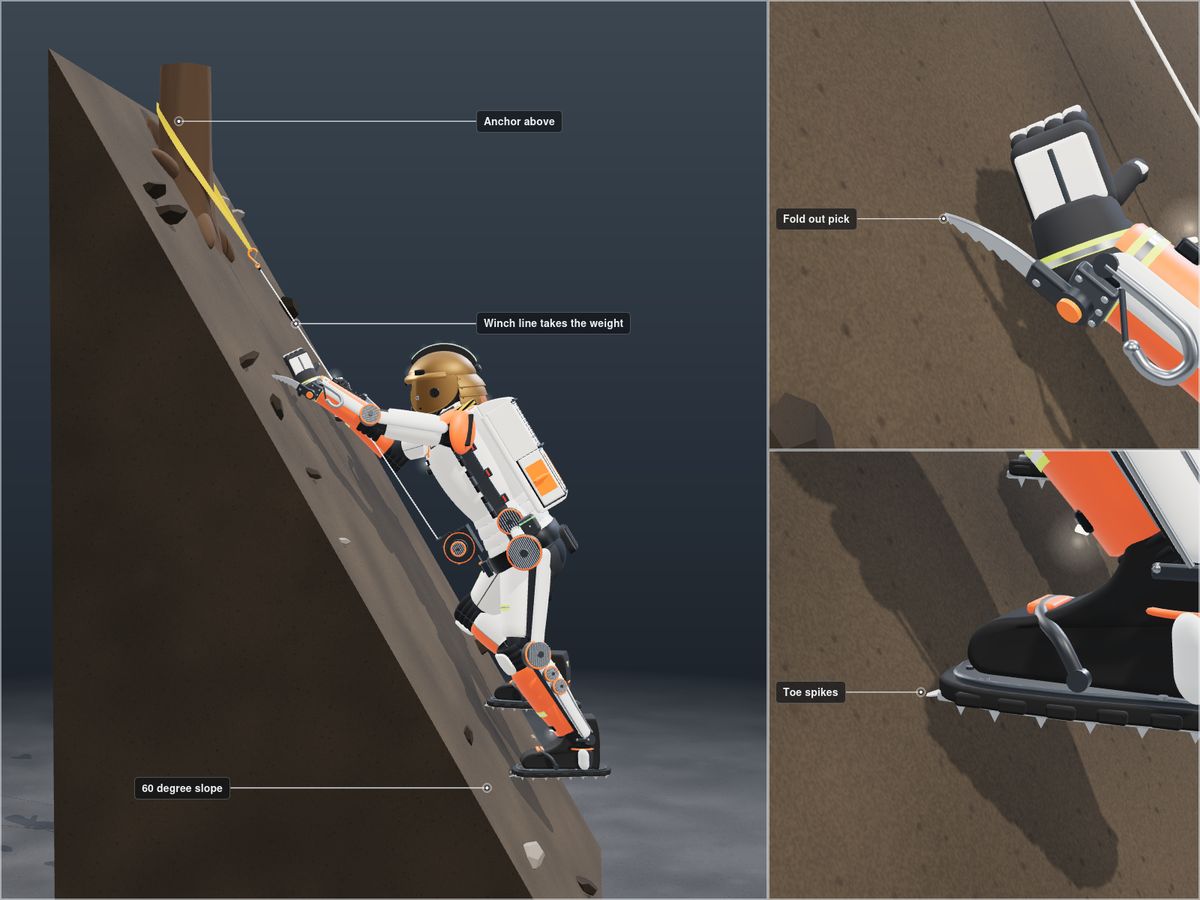
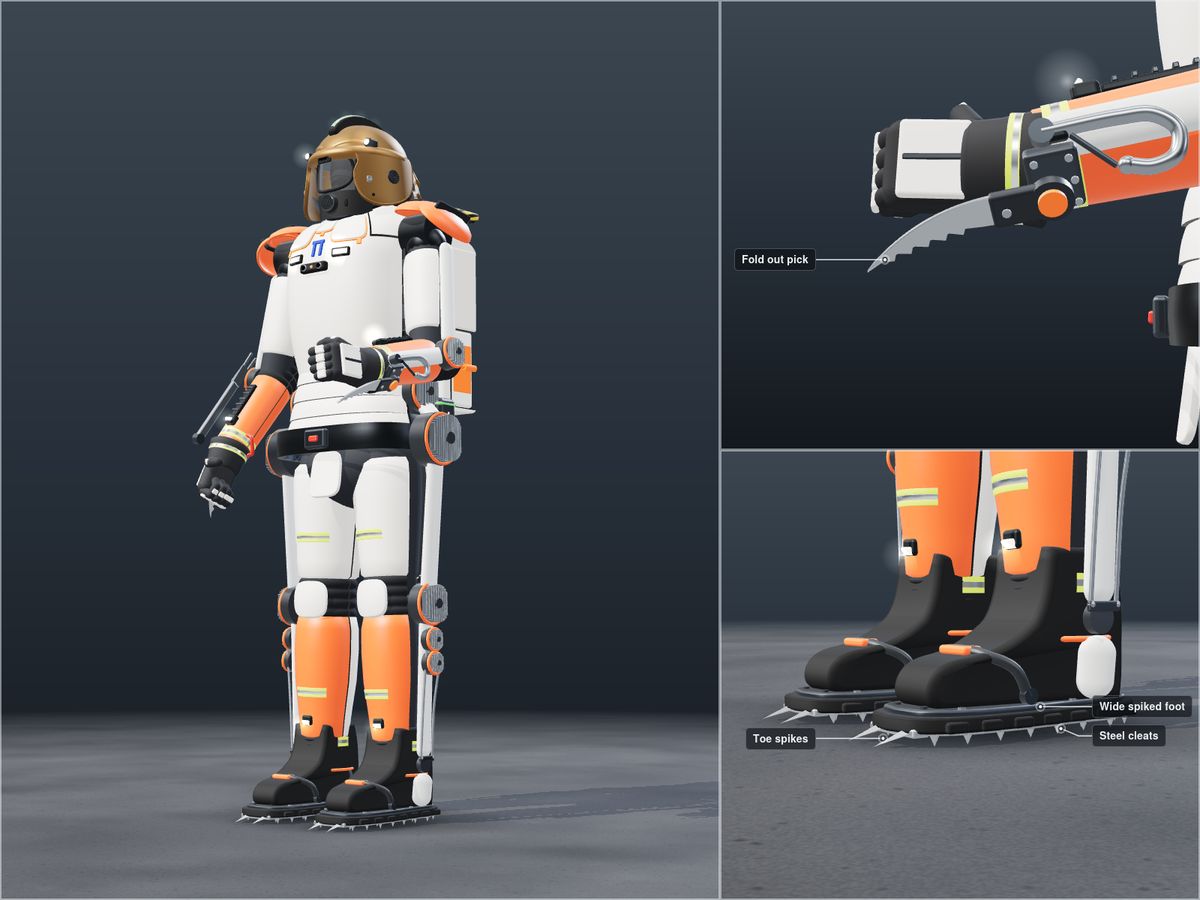
| Fold out picks, pair | Forearm track | 1.8 kg |
| Wide spiked feet with toe spikes | Foot sockets | 2.2 kg |
| Snow plates, pair | Clip on the wide feet | 3.0 kg |
| Spring kit, pair of blades | Shin track and heel | 11.0 kg |
| Rib cage, three hoops | Inside the torso halves | 5.0 kg |
| Front airbags, 150 L | Chest socket and collar | 4.0 kg |
| Wing bags, 350 L | Upper back sockets | 5.0 kg |
| Heavy plate set | Plate clips | 4.0 kg |
| Winch, 30 m line, 1 t | Belt front or belt back | 9.0 kg |
| Rope kit: sling, pulley block, chest ring, 4 carabiners | Hips and chest | 1.5 kg |
| Big light, 15,000 lumens | Either shoulder | 3.8 kg |
| Air set | Upper back sockets | 12.0 kg |
| Blower with filters | Pack side track | 2.0 kg |
| Generator with a day of fuel | Battery slots 3 and 4 | 18.3 kg |
| Beacon, reflector, water tube | Flank track | 0.5 kg |
| Drinking water, 2 L | Pack side track | 2.0 kg |
| Slot box for a medical kit, tools or water | Any free battery slot | 0.8 kg |
| Saw scabbard and holsters | Thigh track | 1.0 kg |
Loadouts by job
| Job | Battery modules | Kits |
|---|---|---|
| House, wood stairs | 3 | Palm hooks, pry tip, rib cage |
| Smoke job, wood stairs | 2 | Palm hooks, pry tip, air set |
| Smoke job, concrete building | 4 | Palm hooks, pry tip, air set, rib cage, big light |
| Collapse and rubble | 4 | Palm hooks, pry tip, rib cage, front airbags, heavy plates, winch, rope kit, big light |
| Mountain and steep ground | 4 | Wide feet, picks, palm hooks, rib cage, front airbags, wing bags, winch, rope kit, beacon, water |
| Snow | 4 | The mountain loadout plus snow plates |
| Flood and water | 4 | Wide feet, palm hooks, front airbags, wing bags, winch, rope kit, big light |
| Wildland saw crew, 14 hours | 2 and the generator | Wide feet, picks, palm hooks, blower, saw scabbard, winch, rope kit, water |
| Night scene, light tower | 6 | Palm hooks, a big light on each shoulder |
| Helicopter hoist | 3 | Wide feet, picks, palm hooks, rope kit, beacon |
Joints
How far each joint moves with every part in place, and the most each one gives.
| Joint | Moves | Peak torque |
|---|---|---|
| Hip, forward and back | 110 degrees forward, 30 back | 695 N·m |
| Hip, out to the side | 15 degrees out, 8 in | 627 N·m |
| Hip twist | 18 degrees out, 45 in | 182 N·m |
| Knee | 130 degrees (100 with the spring blades) | 650 N·m |
| Ankle | 45 degrees toes up, 20 toes down | 513 N·m |
| Ankle roll | Follows the ground | 120 N·m |
| Lower back | 45 degrees forward, 5 back | 798 N·m |
| Shoulder, forward and up | 190 degrees | 251 N·m |
| Shoulder, out to the side | 150 degrees | 251 N·m |
| Elbow | 150 degrees | 120 N·m |
Pictures
Renders from the design's 3D model.
Design files
The Power armor is an open design. Build it, sell it, improve it.
- DesignThe design, the weight sheet with every kit and loadout, and the jobs it is built for
- 3D modelThe whole suit as one web page: turn it, open the front or back, pull a battery, fit the kits
- CalculationsThe scripts behind every number
Make one
Every ΠAN Gear design is open. Build the Power armor, sell it, improve it. Tell us at makers@thepanproject.com and we test it with ΠAN, help you get it right, and feature it here.